Meet Brian Kerr
Brian Kerr helps leaders and teams deal with their most stubborn problems. He combines group facilitation, continuous improvement, and change management to produce shared priorities, practical plans, and conditions for sustained follow-through.
Brian’s goal is to reduce suffering and wasted effort.
Brian has an MS in Information from the University of Michigan and is a Prosci Certified Change Practitioner.
Contact: E-mail Brian / Book a call
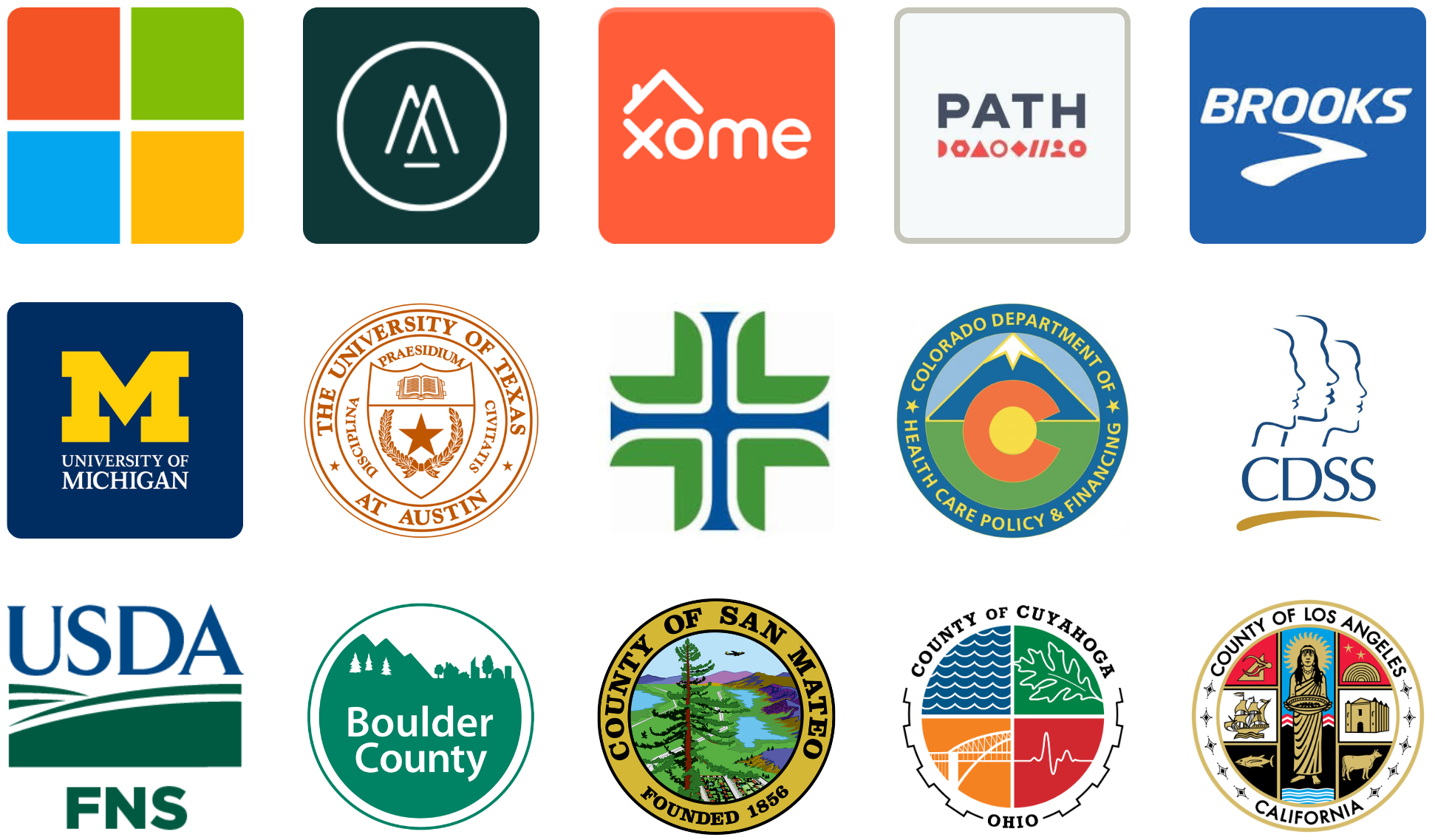
Brian has completed 81 engagements for 30 clients over a 20 year span. Selected client organizations:
Projects
Every project is different. A typical design might be:
- First, gather people together and get to agreement on the problems at hand and some potential solutions.
- Next, set up a measurement system to see what’s going on and respond appropriately over time.
- Then we all roll up our sleeves and go—building on what works while learning from what doesn’t.
Brian’s clients bring difficult problems to work through, curiosity about underlying causes of suffering, and a readiness to try something new.
Brian’s story
I started my first consulting project as a distraction from grad school, and it quickly became my chosen way of working. I worked solo for a decade, and then spent a second decade as a consultant and manager at two consulting firms.
Personal background and approach
After college I got a systems analyst job and enjoyed that for a few years. I went back to school for a Master of Science from the University of Michigan School of Information.
During grad school, I started doing project-based work, and I haven’t looked back. I spent 10 years as an independent technical consultant with emphasis on applying UX methods to increase the value of working software—my ‘changesets for dollars’ era. Eventually I got tired of developing software that didn’t consistently make a dent in my clients’ organizations. Software is only sometimes the answer.
This interest in outcomes led me to learn about applying lean and continuous improvement methods in a variety of larger organizations. For the next 5 years, I worked alongside clients in the public and nonprofit sectors, using and mutating continuous improvement methods to directly benefit the public. Finally, over the most recent 5 years, I’ve practiced additional skills, including approaches to organizational development, change management, and ways to link strategy to measurement.
What I enjoy most about the work is helping people uncover mutually beneficial—often surprising—solutions to big problems. These solutions often originate from employees with lower status; I celebrate when their insights are heard, acknowledged, and realized. I look for ways of communicating and planning that take the usual bullshit, turn it upside down, and use it as fertile soil to grow something new.
My focus is to help my clients and their teams find their way across their most difficult challenges and unpleasant circumstances. I love being able to learn from and work with the ever-expanding set of people I’ve met over the years.
This consulting practice has been one long ‘apprenticeship to the truth’, as Emerson put it. I try many different approaches. I keep and refine the ones that work. All in order to get the most meaningful and durable results for my clients.
Case studies
Lean transformation for government
With new executive leadership, a wave of retirements in upper management, and policy changes mandating urgent adjustments to their services, a county-level agency with 300 staff was running behind. Their new leadership commissioned an agency-wide lean transformation. I designed our approach and led the work with a team of 8 consultants.
Our work started with an agency-wide improvement activity that reduced their backlog of overdue requests from 40,000 to zero in two months, while letting staff practice designing and running rapid improvements in a complex, highly regulated environment. I hosted a series of iterative workshops as they transitioned from an in-person service model to a call center, and reduced their callback rate from 14% to 1%. Staff improved timeliness and compliance of key processes across 5 sites. I trained a cohort of 20 lean champions who took over the agency’s lean efforts after the consulting project ended.
Operating model for marketing tech
Marketing and technical teams inside a large corporation were at loggerheads. They had developed an advanced machine learning (ML) capability to make sense of customer activity and make recommendations to their sellers. The program was successful technically, but coordination and agreement did not come easily.
I managed a business process reset on behalf of dozens of decision-makers and managers across teams to plan and run their shared work around this program. Working with data scientists, we developed ways of explaining tricky machine learning concepts and system behaviors to sales and marketing teams. And working with marketing, we created a deliberative structure so they could identify what was important to them, come to agreement as a group, and share their requirements with data scientists. This new operating model eventually became the basis for division-wide project selection and planning.
Human-centered design for finance
Client billing was a pain point inside a professional services firm. 1,000 employees were involved in drafting and approving a monthly volume of up to 25,000 invoices. Their one-size-fits-none process caused rework and frustration, introduced client-facing billing errors, and impacted the firm’s AR KPIs. An IT-led process redesign had failed catastrophically the previous year, and the problems remained.
I designed and implemented a business-wide project to redesign billing in order to decrease Days Sales Outstanding (DSO). Our small consulting team assembled a working group of partners, executives, and staff across the firm and led them through a user-centered design process to gather internal perspectives and validate customer requirements. We led the working group through set-based design technology selection activities to identify the right approach, technology, and plan to implement a new billing process based on results from user-centered design. This new design was approved by executives and implemented by the firm.
Let's talk if…
You lead a project, team, department, or organization. You are swamped in uncertainty and can’t tell which competing (often opposing) demands will help you in the long run. You need a plan for today, this week, this year that gets you somewhere new and valuable and useful for your customers.
You can look out there, way out, and see where everybody needs to arrive. But how?
Next steps
The best next step is for us to talk. Schedule here:
Want to learn more about the methods and approaches I use to get results?
- Read Improve Something Today
- Peruse the Continuous Improvement Studio